.png)
Outbound sales are seeing a major transformation. Old-school prospecting that relied on spreadsheets, manual searching, and disconnected types of software is being quickly displaced by AI agents, which can source, analyze, and prioritize a number of highly-fit prospects at a scale that is impossible for individuals to achieve.
This is not about replacing SDRs. It is about putting SDRs in a position to optimize their prospecting using intelligent systems that take the grunt work of data input and manual research, allowing insights to materialize in real time.
AI-assisted prospect research will likely become a cornerstone of modern outbound teams, changing the way sellers identify prospects, qualify prospects, personalize their outreach, and engage meaningfully, while liberating human representatives to focus on what they do best: building relationships and closing deals.
Why Is Advanced Prospect Research Critical in Modern Sales Pipelines?
How Have Traditional Prospecting Techniques Become Inefficient?
Traditional prospecting relies on manual, time-consuming research: Googling companies, leveraging LinkedIn profiles, parsing funding announcements, reading job postings, and jumping among various tools to gather context.
This process introduces gaping inefficiencies: a prospect can take several hours to research, data quality varies greatly from one rep to another, and the process simply does not scale to modern outbound targets.
Even worse, manually gathered data grows stale within weeks due to constant shifts in company direction, headcount, technology stacks, and funding. With increasingly faster buyer cycles and mounting competition, the pace of manual prospecting cannot keep up with today's demands.
What Are the Common Challenges Faced by Sales Teams During Manual Prospect Research?
Sales teams all face problems related to the inefficiencies of manual research: reps being overwhelmed by too many sources and not enough synthesis; issues of accuracy from old and incomplete information; and the inability to personalize without automation.
Many SDRs also burn out because they're spending more time gathering data than creating a pipeline. But aside from that, qualification standards become inconsistent when different reps interpret data in different ways. These challenges don't just slow teams down-they directly undermine pipeline quality.
How Is Buyer Behavior Evolving in Response to Irrelevant Outreach?
Where buyers have become increasingly selective and demand outreach that is relevant and deeply informed, generic messages such as "I saw you're hiring" simply won't cut it. Instead, they're looking for insight-driven commentary on their current challenges, proof that the representative truly understands their industry and business model, and messaging that speaks directly to their strategic priorities.
They also expect references to real recent events, not some half-baked assumptions. Reaching this level of precision at scale is virtually impossible to achieve manually, but AI agents make hyper-relevant, contextual communication possible for every rep.
See how OneShot.ai automates prospect research at → https://www.oneshot.ai/
How Do AI Agents Revolutionize Prospect Research Compared to Manual Methods?
What Are AI Agents in the Context of Sales and Prospecting?
AI agents in sales are autonomous or semi-autonomous systems designed to perform many of the tasks traditionally handled by SDRs and BDRs. In prospecting, these agents can search internal and external data sources, enrich contact information, analyze buying-intent signals, generate contextual insights, and identify patterns or triggers across accounts.
Unlike static scripts or rule-based automations, AI agents are adaptive systems that learn, refine, and improve their performance over time, enabling more intelligent and scalable prospecting workflows.
What Capabilities Should an Effective Prospecting AI Agent Offer?
An effective AI prospecting agent should deliver comprehensive data enrichment across multiple sources—including LinkedIn, company websites, tech-stack databases, news outlets, and job boards—while also extracting relevant context such as funding events, hiring shifts, or product announcements.
It should score and qualify leads, detect intent-based behaviors, update data in real time, and sync seamlessly with the CRM. Most importantly, it should surface personalization-ready insights that reps can instantly use in messaging. The objective is simple: remove guesswork and equip sales teams with precise, up-to-date intelligence.
How Do AI Agents Aggregate and Enrich Data at Scale?
AI agents accomplish their aggregation and enrichment of data by combining the power of crawlers, API integrations, large language models, classification systems, entity-recognition pipelines, and pattern-detection algorithms in a single framework.
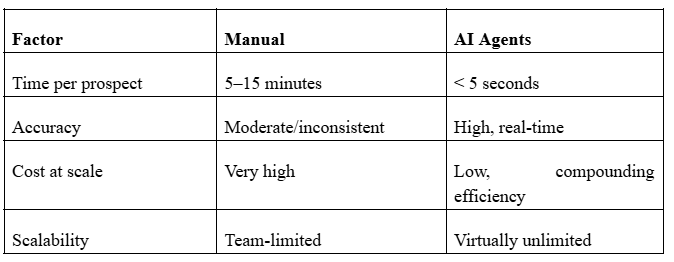
Synthesized information is drawn from sources such as Crunchbase, LinkedIn, job boards, tech-tracking platforms, product-review sites, and historical CRM data. The outcome is a comprehensive and constantly updated perspective on each prospect, which processes much faster and with considerably higher quality compared to manual research.
Manual vs. AI-Driven Research Efficiency
What Are Real-World Use Cases of AI Agents Accelerating Prospect Research?
How Do Sales Development Reps (SDRs) Use AI Agents for Lead Qualification?
SDRs rely on AI agents that can qualify leads more efficiently through automated assessments of the critical buying signals. AI agents assess the prospect’s fit with the ideal customer profile, recent intent signals, technology stack, hiring activity, corporate changes, prior engagement, or even competitor context.
Rather than spending hours collecting and interpreting data, SDRs receive leads that are immediately pre-qualified and contain a wealth of insights that allow them to spend their time on conversations instead of research.
What Role Does AI Play in Competitive Intelligence Gathering?
AI serves in the role of producing and compiling competitive intelligence through large-scale, synthesized use-case analysis. This involves maintaining a continuous pulse on competitors' product changes, pricing updates, wins with new customers, case studies, leadership moves, and strategic announcements.
This information is streamlined into actionable summaries SDRs can replicate during outreach, such as: "I saw you are moving away from {{Competitor}} based on job postings, companies of your size often prioritize faster deployment cycles." Performing the research can provide important contextual details that can be communicated in a way that increases the relevance of the outreach.
Can AI Agents Identify Buying Signals or Trigger Events?
Certainly. AI agents are extremely proficient at identifying real-time signals that hint at buying behavior. They identify funding rounds, leadership changes, technology victories or failures, job posts specific to roles, outages of platforms, geographic and team growth, and new initiatives announced in press releases or annual reports.
These trigger events enable perfectly timed outreach that almost always increases response rates because the message dovetails with what the prospect is experiencing at that moment.
Discover how Insight Agent delivers deep prospect intelligence instantly → https://www.oneshot.ai/
How Does OneShot.ai Utilize AI Agents for End-to-End Prospect Research?
What Is the Role of the Insight Agent Within OneShot.ai’s Ecosystem?
OneShot.ai's Insight Agent is the analytics engine of the entire outbound workflow; it processes firmographic, technographic, and psychographic data while interpreting buying signals, website behavior, competitive context, and historical CRM interactions.
Synthesizing all of these inputs, the Insight Agent transforms raw data into clear, actionable intelligence that reps can plug directly into their messaging. It removes the need for manual research and ensures every outreach attempt is rooted in meaningful, context-rich insights.
How Does the Persona Agent Keep Brand Voice Consistent During Research and Outreach?
The Persona Agent ensures that each email, LinkedIn message, or call script perfectly meets your brand voice, tone, and compliance rules. As it incorporates the insights it picked up from research, the agent molds them to your organization's preferred style, making sure personalization does not drift away from the brand identity. This ensures consistency across all touchpoints of outbound while keeping it highly relevant.
How Do Scaling and Integration Agents Streamline Data Flow Across Sales Tools like HubSpot, Outreach, and Apollo?
OneShot.ai's Scaling Agent optimizes the way research and outreach are distributed across domains, sequences, and sales reps to make sure teams can operate efficiently at high volume without sacrificing deliverability or personalization.
Complementing this, the Integration Agent pushes enriched insights into platforms like HubSpot, Salesforce, Outreach, Salesloft, and Apollo. This continuous synchronization keeps data fresh across the tech stack, eliminates duplicates, and prevents incomplete or outdated records from slowing teams down.
How Does AI-Driven Research Improve Lead Quality and Outreach Relevance?
What Metrics Show the Impact of AI Agents on Prospect Fit and Conversion?
AI-enhanced prospecting offers visible results with improved fit and conversion quality. Teams utilizing AI agents typically see a 20-40% increase in ICP match rate, 30-50% more reply rates driven by deeper context, and 2-4x more pipeline coverage.
Qualification improves as reps spend less time researching and more time engaging with prospects (the template should account for the necessary combination of words here; the anticipated outcome is straightforward—when prospect fit improves, conversion rates will iterate).
How Is Personalization Enhanced by Real-Time AI Research?
Real-time AI research enhances personalization in prospecting by enabling every message to be contextualized to the most recent information. Outreaches become more engaging because they offer timely reference to current events, explicit buyer pain points, industry trends, or external organizational change.
Instead of generic greetings like "Hey {{FirstName}}," reps can send insight-driven messages like, "So you're adding to your RevOps team—most companies at your stage will want to cut down on tool sprawl..." The agent's situational awareness dramatically elevates engagement.
Why Is Relevance the New Personalization in Sales Emails and Messaging?
Modern buyers are not going to accept platitudes like inserting a name or mentioning a company name—buyers need relevance. Buyers want to understand why now, why them, why this problem matters, and why your solution applies.
AI agents empower SDRs to provide this level of deeper relevance in a scalable manner to ensure each message is relevant to the prospect's current situation, priorities, and motivations. In modern sales, it is relevance - not just personalization - that gets you a seat at the table.

What Are the Risks or Pitfalls of Relying Too Heavily on AI Without Human Oversight?
Can AI Misinterpret Context or Industry Nuances?
Yes, AI can sometimes misunderstand context, particularly when niche industry terminology, complex buying committees, emerging verticals, or ambiguous job titles are involved. These are areas where subtle human judgment is still required. While the speed and pattern recognition of AI agents are beneficial, reps should always review insights for accuracy and meaning before using them in outreach.
What Are Risks of Over-Automation in Prospecting?
Over-automation creates serious problems for sales teams. Most often, it creates generic, low-quality sequences with misaligned messaging, compliance concerns, overly aggressive send volumes, and erosion of brand integrity.
The objective of modern prospecting is not to "set and forget" automation but to use AI to complement, accelerate, and enhance human-led selling efforts without sacrificing relevance or authenticity.
How Can Sales Teams Maintain a Human-First Strategy While Using AI Agents?
This human-first approach means teams should validate AI-generated insights before outreach, tailor narratives beyond the AI's initial suggestions, and rely on humans for empathy and judgment while using AI for research and data synthesis.
In such a model, automation is married with human oversight to ensure prioritization remains thoughtful and customer-centric. Here, AI elevates human performance, rather than replacing it.
Conclusion
Advanced prospect research powered by AI agents isn't just a productivity boost; it's a strategic advantage. By transforming raw data into actionable insight, AI lets sales teams focus on high-value conversations rather than manual research.
The outcome is obvious: better-qualified leads, more relevant outreach, and a strong pipeline created at scale. As buyer expectations continue to evolve and competition heats up, teams embracing AI-driven prospecting will always perform better than those leveraging manual processes.
If you're ready to modernize your outbound strategy and give your reps the intelligence they need to win, now is the time to explore AI-powered prospect research with OneShot.ai.
FAQs
1. What is AI-powered prospect research?
AI-powered prospect research uses AI agents to automatically gather, enrich, and analyze data about prospects—such as firmographics, intent signals, and online behavior—to help sales teams target the right buyers faster.
2. How do AI agents improve prospect research?
AI agents scan multiple data sources in real time, identify buying signals, summarize insights, and surface actionable context—eliminating hours of manual research for sales reps.
3. What data can AI sales research agents analyze?
AI agents can analyze company size, industry, funding events, tech stack, job changes, intent data, website activity, and social signals to build accurate prospect profiles.
4. Are AI agents better than traditional sales research tools?
AI agents go beyond static databases by continuously updating data and delivering insights automatically, while traditional tools often rely on manual searches and outdated records.
_(1).png)