


.png)
According to Gartner, "Sales calls convert 42% more often when analyzed with conversation intelligence."
Sales organizations have always understood that deals are made or lost in conversations. Yet, most sales calls are unreviewed, untranscribed, and underutilized. Reps finish a call and move to the next, while lessons learned fade into thin air.
The outcome? Missed opportunities. Under-coached teams. Inconsistent messaging. A pipeline that relies on luck rather than on data to improve.
AI Conversation Intelligence changes everything.
By analyzing sales calls for sentiment, intent, keywords, objections, competitor mentions, and buyer signals, AI turns spoken conversations into data-driven insights. And now, AI-powered platforms like OneShot.ai are combining these real-time intelligence calls with automation and personalization to help sales teams close more deals with less effort.
How Does AI Conversation Intelligence Work in Modern Sales Teams?
What is conversation intelligence, and how is it different from traditional call analytics?
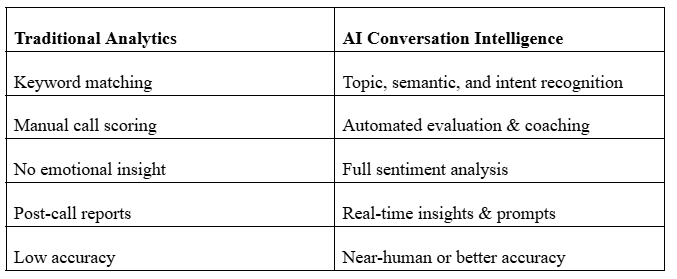
Traditional call analytics systems rely on:
- Basic keyword spotting
- Manual note-taking
- Post-call tagging
- Limited reporting
Conversation intelligence (CI) uses AI—particularly NLP (Natural Language Processing), LLMs, and acoustic analysis—to understand the meaning, tone, and intent within conversations.
Key differences:
To go deeper, see Forrester’s authoritative guide on CI:
https://www.forrester.com/blogs/category/conversational-intelligence/
What key components make up an effective AI conversation intelligence system?
A robust CI system typically includes:
- Live transcription
Facilitates quick and accurate transcription using advanced speech models.
- Sentiment analysis
Identifies emotion from both sellers and buyers.
- Topic extraction
Automatically identifies pain points, areas of interest, and priorities.
- Intent recognition
Differentiates between curiosity, evaluating, being ready to buy, objections, and buying signals.
- Integrations with CRM and sales workflows
Push call insights into Salesforce, HubSpot, Outreach, Apollo, and more.
How are AI-powered call insights from OneShot.ai integrated into the sales process?
OneShot.ai seamlessly pairs the following two agents:
- The Insight Agent collects call insights, pain points, competitor mentions, and next action recommendations.
- The Persona Agent adjusts language, messaging, and follow-ups through the lens of the buyer persona.
These two agents work together to create a continuous intelligence loop that updates call notes, drafts follow-up emails, and refines personalization throughout the sales cycle.
See the Insight Agent in Action https://www.oneshot.ai/demo
Why Are AI-Powered Call Insights Critical for Conversion Optimization?
What do sales leaders gain from tracking call sentiment and objection patterns?
Sales leaders can see powerful insights—unanticipated trends emerging from sentiment, and objection occurrences in the lives of deals—by monitoring call sentiment and objection occurrences. It tracks and shows which objections tend to emerge just before deals go dark, and the commonality of pricing conversations with reps and sales pipelines.
AI even reveals and calculates levels of positive sentiment that tend to align with deals won and observes what is said by a buyer right before a commitment. These insights create opportunities for leaders to coach//their team more effectively, standardize effective concepts, develop forecasts to keep the pipeline healthy, decrease ramp time of reps, and write playbooks based on actual conversations with the buyer instead of assumptions.
How can AI identify high-intent buyers from conversation cues?
AI models detect:
- Explicit intent (“We’re planning to evaluate tools next quarter”)
- Implicit intent (hesitation patterns, follow-up requests, competitor comparisons)
- Tonality shifts showing interest or urgency
- Keyword clusters related to pricing or implementation timelines
What case studies show the impact of conversation intelligence on B2B conversion rates?
General trends across the industry:
- Teams that employ an AI conversation intelligence application like Gong, Chorus, or OneShot.ai have higher close rates of 15%-35%.
- Forrester reported that companies have improved pipeline accuracy by 29% together with conversation intelligence.
- Gong's case studies present examples of reducing the rep ramp time 50%+.
Reference: https://www.gong.io/blog/conversational-intelligence/
Unlock More Qualified Leads With AI-Driven Personalization.
How Can OneShot.ai Automate the Entire Sales Call Lifecycle — Before, During, and After?
What pre-call insights does OneShot’s Insight Agent deliver instantly?
Before a rep even dials in, OneShot's Insight Agent arms them with a complete picture of the prospect, including background information, recent projects, competitor products they may be implementing, and industry-specific challenges. It also creates AI-powered discussion topics unique to that specific buyer, so the representative goes into the call ready and confident.
How does the Personalization Agent tailor real-time recommendations during prospecting?
The Personalization Agent amplifies any live prospecting conversation with suggestions on objection-handling phrasing, dynamic adjustment of talk tracks based on the buyer persona, recommended differentiators against competitors, and instantaneous drafting of personalized post-call messaging. The impact is huge: sales teams that use AI-driven personalization see 30% higher engagement rates, according to McKinsey.
What happens after the call? How are insights reused across the sales funnel?
Work doesn't stop when the Zoom or phone line disconnects. AI auto-drafts follow-up emails based on what was discussed, creates next-step tasks, updates opportunity scoring, and enriches the CRM with accurate tagging. These insights are then reused across sequences, cadences, and playbooks to make sure every future touchpoint benefits from what's been learned on this call.
Streamline Your Sales Stack with OneShot's AI Agents
What Are the Top Benefits of Using AI Conversation Intelligence for B2B Sales?
How does it improve sales team productivity and consistency?
AI-driven conversation intelligence takes the productivity of sales teams to the next level by freeing reps from manual note-taking, providing them with real-time automated coaching, and establishing systemized call structures that reps can execute confidently.
It uncovers best-practice patterns among top performers, speeds up onboarding, and reveals what scripts and talk tracks have been the winners, so every rep is more consistent and productive.
How does AI conversation intelligence impact revenue pipeline growth?
AI empowers high-performing revenue pipeline growth by unleashing hidden bottlenecks, amplifying the messaging that resonates most with your buyers, and improving deal prioritization based on real conversational data. It enables precise forecasting by interpreting call sentiment and arms managers to better coach, especially in mid- and late-stage opportunities where tweaks can make a big difference in outcome.
What specific results have OneShot.ai customers seen using AI-powered call optimization?
Customers using OneShot.ai for AI-powered call optimization have typically seen a 20-35% increase in qualified meetings, a 30-45% increase in reply rates due to personalization stemming from calls, and deal cycles that move 25% faster. Many report higher NPS scores as a result of more relevant, timely, and consistent post-call engagement.
Schedule a Call to Analyze Your Current Sales Conversations

Which Sales Teams Benefit Most from AI Conversation Intelligence Solutions?
Is this tech effective for SMB and enterprise sales alike?
Yes, conversation intelligence delivers value across both SMB and enterprise sales teams. SMBs benefit from faster rep ramp-up, automated coaching that reduces managerial burden, and smarter resource allocation that helps small teams operate like larger ones.
Enterprises gain scaled insights across hundreds or thousands of calls, enhanced manager visibility across regions and segments, and consistent quality standards that align with global sales motions.
What roles benefit: SDRs, AEs, RevOps, or Sales Leaders?
Conversation intelligence supports every core revenue role. SDRs benefit from better qualification and instant call notes that streamline handoffs. AEs gain stronger discovery and improved objection handling through real-time insights.
RevOps teams get cleaner data and scalable insights to optimize processes, while Sales Leaders use the platform for performance visibility and high-impact coaching.
How should teams evaluate ROI before rolling out conversation intelligence?
To accurately evaluate ROI, teams should monitor measurable indicators such as improvement in close rates, gain in call effectiveness, improvement in talk-to-listen ratios, faster pipeline movement, and reduced rep ramp time. These metrics show both the near-term and long-term revenue implications of leveraging conversation intelligence.
How Can You Get Started with OneShot.ai’s AI Conversation Intelligence Tools?
What integrations does OneShot.ai offer to simplify adoption?
OneShot.ai integrates right in with the tools sales teams already depend on, offering native integrations with HubSpot, Salesforce, Outreach, Salesloft, Apollo, and call-analysis platforms like Gong. It also supports auto-importing from Zoom and Google Meet recordings to make conversation centralization seamless without requiring a change in your team's workflow.
How long does it take to deploy and see results?
Teams see meaningful conversation insights in as little as seven days. The process is simple: install the connection, sync recent calls, configure Insight Agent rules, and insights begin flowing in automatically, along with AI-generated follow-up drafts with coaching suggestions. A typical result: “A SaaS sales team reduced ramp time by 45% within the first month.”
What support does OneShot provide during onboarding?
OneShot.ai provides full onboarding support: from direct Customer Success guidance to live workflow-building sessions; from a complete documentation hub to step-by-step video tutorials; and finally, access to proven AI best-practice playbooks that ensure fast, confident adoption across the sales team.
Book Your Free AI Readiness Consultation
What’s Next in the Future of AI-Powered Conversation Intelligence?
How are large language models evolving to analyze intent more accurately?
Large language models are rapidly improving their ability to interpret buyer intent through enhanced multi-turn conversation reasoning, identifying more subtle tone and emotional signals, generating predictive buyer-intent scores, and real-time coaching to help reps craft more productive responses.
These improvements enable AI not only to understand what buyers say but why they say it, which produces far more accurate intent analysis. Technical reference: see the linked research paper.
What ethical concerns or data privacy considerations should the team address?
With the increasing power of conversation intelligence, teams must have GDPR-compliant consent for recording calls, ensure secure data storage practices, and maintain transparency around when and how AI is used.
Ethical usage of buyer information needs to be paramount, along with implementing robust bias-mitigation techniques to help bring fairness into interactions. OneShot.ai is bound by high standards of privacy, encryption, and compliance that safeguard customer and prospect data.
What are the upcoming trends in machine-to-human sales communication?
Emerging trends point to a future where AI agents play an even larger role in sales interactions: digital twin sales reps that simulate buyer behavior, predictive objection handling that can anticipate concerns before they're even raised, and fully automated conversation QA to ensure quality at scale.
Other advances include real-time competitive intelligence delivered mid-call and AI agents capable of autonomously scheduling next steps, reducing manual work for reps to focus on relationship-building.
Conclusion
AI Conversation Intelligence is now a must-have for sales teams that want to convert more calls into real opportunities. By automatically extracting insights, surfacing buyer intent, and generating personalized follow-ups, AI helps reps sell smarter and faster.
With OneShot.ai, these insights flow directly into your workflows—so every rep gets the context, messaging, and next steps needed to close more deals with less effort.
Ready to transform your sales calls into conversions? Try OneShot.ai today.
FAQs
1. What is AI conversation intelligence?
AI conversation intelligence uses artificial intelligence to analyze sales calls and meetings, extracting insights like buyer intent, objections, sentiment, and next steps to improve sales outcomes.
2. How does AI turn sales calls into conversions?
AI analyzes call transcripts in real time or post-call to identify winning talk tracks, missed opportunities, and buyer signals—helping reps respond better and close more deals.
3. What data does conversation intelligence analyze?
AI tools analyze call recordings, transcripts, keywords, sentiment, talk-to-listen ratios, objections, and competitor mentions to surface actionable insights.
4. Which teams benefit most from AI conversation intelligence?
Sales, customer success, and revenue operations teams benefit by improving coaching, forecasting accuracy, deal execution, and conversion rates.
5. Is AI conversation intelligence better than manual call reviews?
Yes. AI scales call analysis across thousands of conversations, delivering consistent insights faster than manual reviews.
6. What tools offer AI conversation intelligence?
Popular tools include Invoca, Outreach AI (Kaia), and other call-tracking and conversation-analysis platforms, depending on use case and integration needs.
.png)

