


.png)
What Is AI-Powered Win/Loss Analysis in Competitor Intelligence and Why Is It a Game- Changer for Sales Teams?
In B2B selling, winning or losing a deal often hinges on one key factor: how well your sales team understands the competition.
But, Gartner says, sales teams are losing up to 30% of deals due to the failure to capture competitive insights. That's not because they're not trying—it's because they can't see.
Win/Loss Analysis involves analyzing buyer comments, sales history, and competitor behavior to understand why deals are lost or won. Historically, this has been a post-mortem activity—manual and too late to affect results.
But AI is turning win/loss analysis into a living, breathing intelligence engine. New AI-driven win/loss systems provide competitive enablement, reveal buyer decision insights, and maximize win rates in real-time through sales deal intelligence and pattern detection.
How Does Traditional Win/Loss Analysis Fall Short in Modern Sales Environments?
Why are manual post-mortems insufficient for fast-paced sales cycles?
Manual reviews occur after deals close—weeks or months later. By the time that happens, market conditions or buyer sentiment have changed. These tardy insights seldom help sellers make changes mid-cycle or revive future opportunities.
What are the limitations of CRMs and spreadsheets in tracking deal outcomes?
CRMs log results, not motivations. Sales reps tend to label deals as "lost to competitors" or "no decision," but without organized context—such as pricing objection, feature deficiency, or competitor impact—information is flat and useless.
What are the most common bias factors that destroy conventional win/loss reviews?
Cognitive bias is the quiet assassin of objectivity. Reps tend to overdeclare pricing as a factor in loss or undervalue competitor differentiation. Without automation and collective analysis, emotional bias creeps into strategy.
Still guessing after the sale? Watch how OneShot.ai provides AI-powered win/loss clarity in real-time. Discover OneShot.ai →
How Can AI Revolutionize Win/Loss Analysis Through Real-Time Competitive Intelligence?
What role does AI play in aggregating buyer signals and objections?
AI systems extract information from emails, call records, CRM fields, and social interactions to identify buyer hesitation, objection topics, and competitor mentions—well before deals close.
How can machine learning reveal significant trends in lost and won deals?
Machine learning detects repeating variables—such as "competitor X slashes prices" or "buyers react positively to Y use-case messaging." It continually trains models as new deal data is added to the system.
How does AI distinguish between fixable and non-fixable loss drivers?
AI enables the distinction between controllable (pricing, messaging, timing) and non-controllable variables (budget holds, internal politics). This makes teams concentrate only on repairable levers that drive win rates directly.
What kind of insights become apparent with NLP used in sales dialogue?
Natural Language Processing (NLP) analyzes verbal and written conversations to flag competitor positioning, sentiment change, and consistent buying language—providing teams with actionable insights for next calls.
What Are the Key Benefits of Using AI-Based Competitor Intelligence for Sales Outcomes?
Which sales metrics see the biggest lift from AI-powered win/loss insights?
- Teams utilizing AI intelligence usually experience:
- Increased winning rates due to better objection handling
- Accelerated feedback loops for product-market fit
- More precise pipeline forecasting
How does AI assist in finding hidden patterns of competitor positioning?
AI can identify subtle changes in competitor messaging (from LinkedIn or email mentions), pricing trends, or feature prioritization—well ahead of when these become externally visible.
How can these insights enhance pricing strategy, messaging, and buyer personas?
By linking purchaser sentiment with deal results, AI refines value messaging, persona targeting, and price tiers, leading to more impactful campaigns and losing fewer deals.
Major Advantages (Facts):
- Identification of loss trends 30% faster (HubSpot)
- 25% increase in battlecard accuracy (Gartner)
- 2 times messaging effectiveness when personalized by AI buyer signals
How Does OneShot.ai Enable AI-Driven Competitor Intelligence Through Automated Prospect Insight?
What is the Insight Agent, and how does it generate real-time buyer intelligence?
The Insight Agent continuously monitors engagement data—email replies, call notes, LinkedIn activity—to detect signals like competitor mentions, objections, and changing priorities.
How do the Personalization and Scaling Agents turn insights into conversion?
- Personalization Agent: Adapts outreach messaging based on detected buyer signals.
- Scaling Agent: Replicates winning messaging patterns across teams for consistent performance.
What competitive signals can be detected from prospect responses across email and LinkedIn?
AI detects competitor keywords (“we’re already using…”), objection phrasing (“too expensive”), and tone changes that hint at deal risk or switching intent.
How does OneShot.ai integrate these insights into your existing sales tech stack?
Seamless integration with Salesforce, HubSpot, Outreach, and LinkedIn Sales Navigator ensures that every rep operates with contextual, AI-driven intelligence—no tab switching required.
Turn every deal into a data-driven advantage. Explore how OneShot.ai automates win/loss insights today.
What Are the Core Components of an Effective AI-Powered Win/Loss Program?
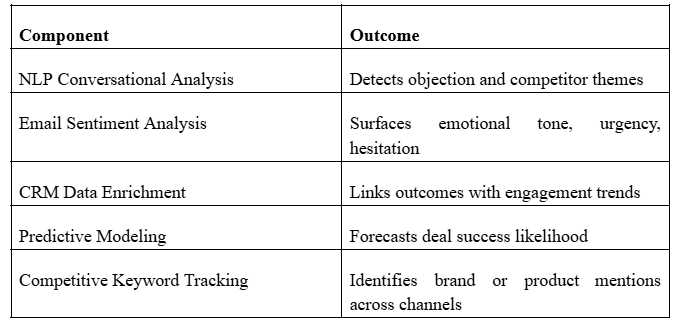
Which primary data sources should drive your AI competitive engine?
CRM logs, call recordings, email threads, proposal histories, and marketing interactions will deliver the raw materials.
- What should your AI model measure - what questions must be answered?
- Why are we losing deals by segment or product line?
- Which competitors are showing most often in losses?
- What are the patterns that define our fastest closing wins?
How can we modify the system to fit our product-market fit?
AI models should capture industry context, buyer personas, and deal complexity to ensure visibility and recommendations stay relevant and actionable.
How Can Sales and RevOps Teams Make AI-Driven Win/Loss Insights Operational?
What actual workflows should be infused with competitive analysis insights?
- Daily stand-ups with win/loss updates
- Weekly RevOps dashboards showing competitive stress
- Monthly enablement syncs with refreshed talk tracks
How can sales leadership respond to these insights?
By turning insights into battlecards, training modules, and GTM playbooks, leaders keep teams ahead of the curve, not playing catch-up.
How can battlecards and talk tracks be dynamically updated from AI signals?
AI platforms auto-refresh competing battlecards from real-time conversational intelligence so reps always possess up-to-date counter-messaging.
What does continuous enablement feel like?
Always-on intelligence makes sales enablement dynamic—continuously responding to changing competitive dynamics.
How Does AI Win/Loss Intelligence Impact Future Pipeline Strategy and Forecasting?
How can AI-detected patterns shape ICP refinement or targeting shift?
AI identifies which buyer personas convert the quickest, making it possible to target more accurate ICP optimization and pipeline prioritization.
What predictive insights can AI deliver to win more competitive deals?
Predictive scoring indicates high-probability wins and notifies teams of deals at risk, making early intervention with targeted responses possible.
How do teams utilize win/loss insights to maximize campaign messaging?
Marketing and sales are aligned with proven buyer data so that outreach, ads, and campaigns speak to actual objections in the field.
Don't guess why deals are lost—know it in real time.
See how OneShot.ai provides an intelligence advantage for your sales team →

What Are the Most Common Pitfalls When Implementing AI-Powered Win/Loss Tools?
What are the misconceptions about “plug-and-play” AI in sales intelligence?
AI models need clean, labeled, and ample data—they're not magic tricks. Teams have to standardize deal records and sales notes first.
What data gaps can undermine AI conclusions?
Missing outcome fields, inconsistent CRM notes, and incomplete transcripts can mislead insights.
How can bias or overfitting lead small data sets astray?
Training AI on too small a number of deals creates false correlations (e.g., "Competitor X always wins on price"), which results in poor decisions.
What internal change management is needed?
Sales teams need to learn to have faith in AI suggestions and integrate insight review into daily sales cycles. Quick Fixes Checklist:
✅ Standardize CRM data entry
✅ Centralize conversation transcripts
✅ Train reps on data hygiene
✅ Review AI outputs monthly
What Success Stories Show the Power of AI Competitor Intelligence in Action?
Case Study: How a SaaS Team Reversed a Declining Win Rate with OneShot.ai
A SaaS firm in the middle market used OneShot.ai to analyze six months of deal data. AI determined that 60% of losses associated with a competitor's pricing bundle were in no way identified by the reps.
Who benefited (Stakeholders):
- Sales Reps: Better talk tracks
- Marketing teams: Better positioning
- Leadership: Smarter forecasting
What Are the Best Tools and Technologies Supporting AI-Driven Competitor Intelligence?
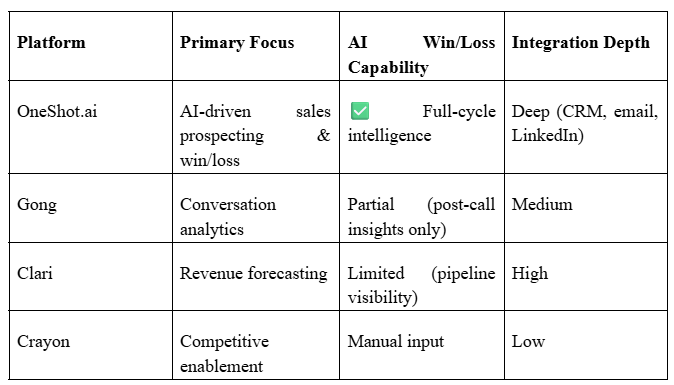
How does OneShot.ai compare to Gong, Clari, and Crayon?
Which systems would be mission-critical?
CRM, call intelligence tools, and Marketing analytics are the backbone of providing complete visibility.
When should I build VS to buy my internal AI analysis?
Most organizations feel that buying a pre-trained, domain-specific AI system like OneShot.ai is faster and more reliable.
How Will AI-Powered Competitor Intelligence Evolve in the Next 3–5 Years?
What future features will enhance win/loss accuracy?
Look for predictive emotion insights, automated buyer sentiment maps, and real-time competitor intent monitoring based on integrated data streams.
Will generative AI affect seller guidance and deal desk decisions?
Yes. GenAI will automatically create customized playbooks and conversation tracks from real-time deal data—doing away with static sales guides altogether.
How will buyers' digital footprints enable deeper AI learning?
With more consent-based data, AI will cross-check buyers' actions across multiple channels—providing unprecedented precision in deal forecasting.
AI-powered win/loss analysis doesn’t just explain why you lost a deal—it teaches your team how to win the next one. With tools like OneShot.ai, every interaction becomes a data point in a larger competitive strategy.
Don’t guess. Know. Win. Request your demo at OneShot.ai →
FAQs
1. What is AI-powered win/loss analysis?
AI-powered win/loss analysis uses artificial intelligence to analyze sales outcomes, buyer feedback, CRM data, and call transcripts to identify why deals are won or lost. It helps teams uncover patterns around competitors, pricing, messaging, and sales execution.
2. How does AI improve competitor intelligence?
AI enhances competitor intelligence by automatically detecting trends across large datasets, surfacing insights about competitor strengths, weaknesses, and positioning. This enables sales, marketing, and product teams to respond faster and refine go-to-market strategies.
3. What data is used in AI win/loss analysis?
Common data sources include CRM records, sales call recordings, email conversations, deal notes, surveys, and market data. AI models analyze this information to generate objective, scalable insights that manual reviews often miss.
4. Are there free win/loss analysis tools or templates?
Yes. Many companies start with free win/loss templates or basic analytics dashboards. Some AI platforms also offer free trials or limited analysis features to help teams validate value before investing in full-scale solutions.
5. Who should use AI-powered win/loss analysis?
AI-powered win/loss analysis is valuable for sales leaders, RevOps teams, product managers, and competitive intelligence teams who want data-driven insights into deal outcomes and competitor positioning.
.png)


