.png)
Many SaaS companies experience an average B2B sales cycle length of about 83 days, with B2B enterprises extending beyond 100 days. Long sales cycles cost you time, money, and momentum. Manual prospecting, outreach, and follow-up can contribute to that drag. Artificial intelligence (AI) helps to shift the authority for proof of concept from the sales rep to the AI service.
AI doesn't replace your sales reps; it empowers them to move leads faster and smarter through the funnel. OneShot.ai enables you to speed up sourcing, research, messaging, automation, and scale all in one. Let's discuss brief implications with specific tactics for using AI to shorten your sales cycle and make an impact.
What Is a Sales Cycle and Why Does It Often Slow Down?
What are the key stages in a typical B2B sales cycle?
A standard B2B sales cycle includes several important stages. Discovery is the first state when a need is confirmed, and we engage with the prospect for the first time. Next is Qualification, when we confirm that the prospect is a fit, has a budget, and we have identified the Decision Makers. During outreach, we send out messages or schedule time to go over our checklist or problem-solving process.
The follow-up/nurturing state is about managing objections and sharing proposals. The last state, closes, is negotiating the terms of the agreement and signing the deal. Having a general idea of each state in the sales cycle will help identify backlogs and assist in reducing the cycle.
What are the most common friction points that delay sales cycles?
Common friction points that hold up sales include the time wasted on manual lead sourcing (data collection) and time spent on research (not getting good insights). The response rates go down when we send generic messages.
Many companies use poor CRM tools, which results in not capturing everything for follow-ups.
Lastly, inefficient hand-offs between teams and/or longer phases of nurturing slow down progress. Solving these points will help streamline and reduce deal closure.
How has AI transformed the sales development landscape?
In hindsight, we transitioned from simple CRM systems (which captured leads) → to sales automation (sequencing, reminders) → and now, personalization & intelligence are driven by AI.
One example, according to McKinsey & Company, is that generative AI use-cases across B2B sales can improve productivity, streamline processes, and increase profitable growth. McKinsey & Company
At the same time, benchmark sources estimate average sales cycles are 84 to 102 days, depending on deal size and industry.
Wondering how AI tools such as OneShot.ai can solve these bottlenecks - often within hours? Let’s get to the tactics.
What Are 5 Proven Ways AI Can Shorten Your Sales Cycle?
1. How does AI-powered lead sourcing eliminate top-of-funnel delays?
One of the largest time wasters in outbound is who and how to reach them. AI software such as OneShot.ai eliminates lead sourcing by automatically finding ICP-matching leads in real time, using predictive modeling along with data enrichment.
That way, your SDRs don't sit around waiting for the list to be compiled — it's ready to go, clean, enriched, and primed.
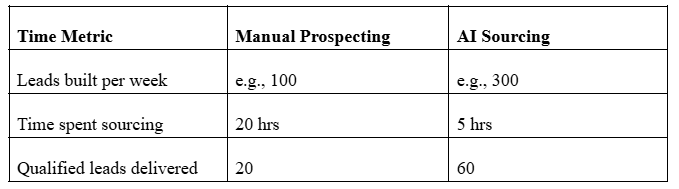
By moving sourcing from manual to AI-driven, you achieve more volume of better leads, sooner in the funnel — enabling quicker movement into outreach.
2. How can automated prospect research boost response rates and meeting bookings?
Once you have leads, knowing them is the next time-saver. The system pulls company information, role information, intent signals, and recent triggers through OneShot.ai's Insight Agent so that your outreach is relevant, not generic.
Studies demonstrate that targeted outreach significantly enhances outcomes: targeted cold email copy can increase reply rates by as much as 32.7%.
By arming your reps with context-filled insights in real-time, you eliminate hours of painstaking legwork and enhance the likelihood a prospect will respond promptly — fewer dead leads and quicker meeting booking.
3. How does AI-driven personalized messaging move leads through the funnel faster?
When your messaging is too generic, prospects respond more slowly — or not at all. With AI-powered Personalization Agents (part of OneShot.ai), you can create customized outreach across channels: email, LinkedIn, voice drops, and multi-touch sequences.
Features include A/B testing subject lines, tone optimisation for defined personas, and message sequencing to maximise the prospect's behavior.
For instance: a split-test where personalized outreach generated 2× higher Reply or Click-To-Open rates. Since quicker replies equate to less back-and-forth, the lead progresses more rapidly from qualification to demo to interest.
4. How does integrated outreach automation reduce pipeline friction?
A big drag occurs when tools don't communicate with one another: leads are in CRM, outreach in some other platform, follow-up in email — siloed. AI platforms such as OneShot.ai have Integration Agents that connect with CRMs and engagement platforms (HubSpot, Apollo, Outreach, Salesloft).
This entails:
- Leads automatically move into cadence, no export/import hassle
- Activities update CRM automatically, cutting admin time
- Follow-ups fire consistently, no lost leads or dropped sequences
✅ Checklist: Top Integrations Sales Teams Require for Velocity
- CRM (HubSpot/Salesforce)
- Engagement platform (Outreach/Salesloft)
- Data enrichment/intelligence feed
- Messaging channels (Email, LinkedIn, Voice)
- Reporting dashboard & analytics
By keeping your tech stack connected and automated, you minimize hand-off lag, eliminate lead leakage, and shorten cycle length.
5. How does smart AI scaling maintain quality while increasing velocity?
Historically, scaling outreach meant giving up personalization, so you can either increase quantity or quality. Today, artificial intelligence can be your scalable agent (like OneShot.ai), giving you the ability to build to scale and still effectively have targeted outreach that's persona-driven.
For instance, you could do thousands of touches, yet each one is modified to the individual, their role, their company, and context. McKinsey says AI in B2B selling has a disproportionate opportunity in increasing seller productivity and streamlining processes. McKinsey and Company
Quick Wins: 3 Metrics That Improve when you scale with AI
- Deal Velocity ↑
- Opportunity-to-Close ↑
- Customer Acquisition Cost ↓
Not only would you send more, you'd send more intelligently, leading to more meetings, faster movement, and faster time-to-close.
Interested in scaling your outreach without losing your voice? OneShot.ai does just that. → Schedule a personalized demo.
How Do AI-Powered Sales Technologies Compare to Traditional Methods?
What is the ROI of AI implementation in outbound sales?
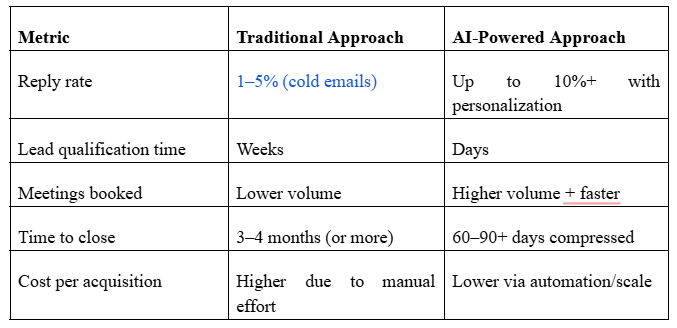
When utilizing AI, you have greater output, faster speed, and greater efficiency — ultimately shortening the period and saving costs.
Who are real-world teams finding success with AI in the sales cycle?
While there may not be many public individualized case studies of OneShot.ai, the value of AI in sales continues: companies using generative AI across sales teams have realized step-change productivity and pipeline velocity.
Many teams report doubling reply rates, shortening lead qualification time, and engaging more prospects in less time.
In summary: If your technology stack has manual sourcing + generic messaging + tools, it is likely you are falling behind.
What Are the Best Practices for Implementing AI to Accelerate Sales Cycles?
How can sales teams choose the right AI tools for their workflow?
✅ Features to consider:
- Real-time data enhancements and lead scoring
- Multi-channel personalization (email, LinkedIn, calls)
- Rich integrations with CRM/engagement solutions
- Industry-standard security/compliance (GDPR, CAN-SPAM)
- AI-trained voice/persona bundles
- Dashboarding for velocity/rate metrics
Selecting a tool that fits into the environment and your process will ensure your users adopt it more quickly and drive cycle time gains faster.
What are the common mistakes to avoid when adopting sales AI?
In implementing sales AI, resist pitfalls that minimize its efficacy. The "set-it-and-forget-it" approach is a significant error—AI requires constant monitoring, maintenance, and training to remain effective.
Human oversight can similarly create issues, as automated contact still needs to be reviewed for tone and applicability. Align with your CRM and technical stack to avoid inefficiencies, and don't neglect data hygiene—imprecise or outdated lead information can sabotage automation.
How do you measure the right metrics post-adoption?
Following adoption, identify monitoring key performance metrics to gauge impact. They are time to first response, lead-to-qualify rate, opportunity-to-demo conversion, average time from qualified lead to close, and sales velocity (deal value divided by days in funnel). Comparing these "before vs. after implementing AI" offers clear visibility into performance improvements and areas for optimization.
Where can you test drive AI without a steep learning curve?
Look for platforms that include guided onboarding, templates, example sequences, and support. Consider OneShot.ai. It has an intuitive setup and dedicated support to help you. Don't just shorten your sales cycle, reimagine it. Try OneShot.ai → Start Free Trial.
What’s Next? How Can AI Future-Proof Your Sales Pipeline?
What emerging AI features should sales leaders monitor?
- Generative AI for end-to-end pipeline orchestration (not outreach alone)
- Personalization in real-time video or interactive outreach
- Voice outbound AI (calls, voicemail)
- Predictive analytics to optimize decision timing and next best actions
How will the role of the B2B rep evolve with broader AI adoption?
Sales reps will evolve from email senders and list builders to relationship strategists and deal architects. They'll dedicate more time to closing, negotiation, value conversation—and less time to manual outreach, list building, and fundamental research.
What’s the long-term win for companies that adopt sales AI today?
Compound productivity gains: as AI learns your brand/personas and data improves, efficiency increases
Lower overhead and less reliance on large SDR teams
Market agility: faster time-to-engagement, faster to close, shorter cycles
Competitive positioning: if your competitors still use manual workflows, you’ll have a velocity advantage
The future of B2B sales doesn’t wait. Start shortening your cycle with OneShot.ai today. → Book your 1:1 demo

Conclusion
In the current B2B environment, where decision-makers are used to speed, relevance, and personalization, long sales cycles are a liability. Advancing the use of AI across sourcing, research, messaging, automation, and scaling can help shrink the sales funnel, engage more prospects sooner, and close deals faster.
You can leverage the right AI-enabled platform like OneShot.ai, adopt best practices, and measure the right metrics to accelerate sales as a practice. Your sales cycle doesn't have to take 100+ days. It can be shorter, sharper, and more efficient. Are you ready?
FAQs
1. How does AI help shorten the sales cycle?
AI reduces the sales cycle by automating lead qualification, prioritizing high-intent prospects, personalizing outreach at scale, and accelerating follow-ups—helping deals move faster through the funnel.
2. Which sales stages benefit most from AI?
AI has the biggest impact on prospecting, lead scoring, outreach, and follow-ups, where speed and accuracy directly influence how quickly deals progress.
3. What are examples of AI tactics that speed up sales?
Common tactics include AI lead scoring, intent-based alerts, automated outreach sequences, predictive next-best actions, and real-time conversation insights.
4. Can AI improve close rates as well as speed?
Yes. By engaging the right prospects at the right time with relevant messaging, AI improves both deal velocity and close rates.
5. Is AI sales automation suitable for small teams?
Absolutely. AI helps small sales teams do more with limited resources by reducing manual work and focusing effort on the highest-value opportunities.
.png)
.png)