


.png)
In the AI age, competitor intelligence has stealthily emerged as one of the largest levers for sales performance. Where in the past it was a manually intensive process that could take hours of research, note-taking, and tracking gargles around the industry, competitor intelligence now can be a strategic advantage to your team, powered by automation and large-scale analysis of data.
AI not only enables competitor research to happen a lot faster; it also changes the way sales teams understand markets, prospects, and positioning. This article unpacks how modern teams leverage AI to analyse competitor intelligence, personalize outreach, and win deals.
What Is Competitor Intelligence and Why Does It Matter in Sales?
Competitor intelligence is the process of collecting and analyzing information about competitive offerings, strategies, tactics, and messaging. In sales, it has implications for everything from objection handling to pricing discussions to developing targeted outreach.
How do modern B2B sales teams use competitor insights to boost performance?
Structured competitor intelligence is the rising star in driving performance improvement and win rates of modern B2B sales teams. Understanding which competitors are most active within their ideal customer profile, with this kind of real-time information, enables sellers to anticipate objections before they may surface on calls, tailor product comparisons during demos, and position strengths directly against competitor weaknesses.
Competitor intel enables teams to identify prospects who may be newly dissatisfied with a rival provider or can spot early market shifts in new pricing structures or feature releases. Data-driven teams now replace anecdotes with systematic insights to drive messaging refinement, more accurate lead scoring, and precise forecasting of deal risk.
What types of competitor data are most valuable in B2B prospecting?
Pricing models and discounting behaviors, product roadmaps and release updates, and a clear insight into each competitor's value proposition and market stance usually comprise the most valuable data related to competitors in B2B prospecting. The high-performing teams also track competitor customer movements such as logo wins and churn indicators, coupled with hiring trends that signal strategic shifts.
Review sentiment from platforms like G2, Capterra, Reddit, and X provides additional intelligence, as do publicly accessible sales plays, enablement assets, and case studies. All these collectively serve as guidelines for teams to focus their efforts on accounts that have a higher probability of converting and to avoid those demonstrating long-term loyalty to competing solutions.
How does competitor intelligence support personalized outreach?
Competitor intelligence also enhances personalized outreach by providing a clear and contextual grounding for it. Sellers can mention known pain points associated with a prospect's current tools, frame their solution as a better alternative to competitor shortcomings, and craft value propositions based on the technologies the prospect currently uses.
Demos can be tailored to highlight the gaps in alternative products, making that comparison immediate and meaningful. This leads to "category-native personalization," which is one of the top-performing personalization styles in today's B2B sales for upping relevance, credibility, and response rates.
How Can AI Improve the Way You Gather Competitor Intelligence?
What are the limitations of manual competitor research?
There are a lot of limitations to doing competitor research manually, which makes the process slow, inconsistent, and finally unreliable for modern B2B sales teams. That is because it involves sellers going through websites, price pages, and review platforms manually, which takes up hours and almost always yields incomplete results since humans cannot recognize patterns hidden across thousands of data points.
Tracking is reactive; this means that teams find out about competitive changes only when prospects mention them. Since each team member notes insights in a different way, consistency is lost. In moving markets, intelligence gathered this way becomes stale in days and even hours.
How does AI automate and scale competitive monitoring?
AI overcomes these limitations by automating and scaling competitive monitoring. It can continuously extract messaging from competitor websites, blogs, and product announcements, monitor pricing adjustments and promotional campaigns, and parse customer reviews to surface recurring themes.
AI monitors hiring activity, layoffs, and role changes while detecting shifts in ad spend, SEO strategy, or social content. Beyond external signals, AI can even identify competitor-specific objections appearing across recorded sales calls. Rather than spending time on research, sellers get real-time alerts and succinct insights that can be acted on immediately.
Which data sources can AI analyze that humans can’t efficiently?
AI is also capable of processing sources of data that humans cannot efficiently do at scale, such as thousands of competitor reviews, social listening streams across multiple platforms, and large volumes of product release documentation.
It can parse public financial disclosures, track job postings across global markets, and monitor subtle changes in competitor metadata or on-page web copy. AI can even identify sentiment patterns across niche forums, online communities, and industry groups, providing a breadth and depth of competitive visibility unmatched by the capability of manual research.
Suggested Table: Manual vs. AI-Powered Competitor Analysis
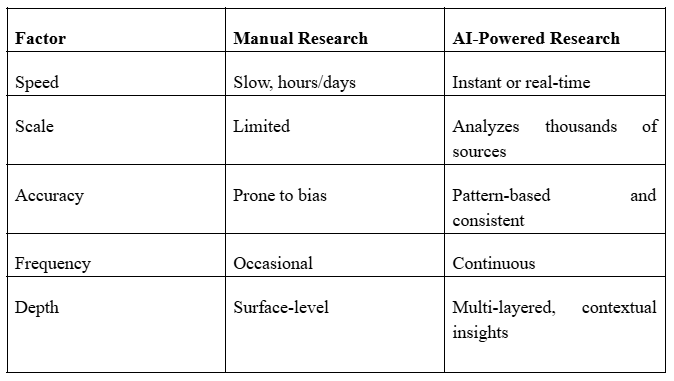
Multi-layered, contextual insights
→ Looking to automate your sales insights? Discover how OneShot.ai’s Insight Agent uncovers deep, real-time intelligence on prospects and competitors.
Which AI Tools Help You Track Competitor Activity Effectively?
Which AI-powered platforms specialize in competitive intelligence (Crayon, Kompyte, Klue)?
These competitive intelligence platforms, such as Crayon, Kompyte, and Klue, focus on tracking competitor products, automating battlecards, sending pricing change alerts, summarizing market movements, and supporting win/loss analysis programs. They do this by offering reliable, competitive enablement that keeps your sellers and marketers in alignment with the latest shifts in the competitive landscape.
What role do all-in-one tools like OneShot.ai play in combining prospect and competitive research?
All-in-one platforms like OneShot.ai extend beyond traditional competitive intelligence by combining prospect insights with competitor data in one workflow. They deliver AI-generated messaging tailored to the competitive context, surface which competitors a prospect is likely evaluating, and tie competitor information directly into personalized outreach and sequencing. This creates a unified, holistic view of both the prospect and the competitive landscape-something point solutions typically cannot provide.
Can sales teams use general-purpose AI (like ChatGPT, Gemini/Bard) for competitor monitoring?
Sales teams can also use general-purpose AI tools such as ChatGPT or Gemini/Bard for some of the competitive tasks: summarizing feature sets, creating battlecards, extracting messaging from public sites, and generating objection responses based on competitor claims.
However, all of these models lack real-time monitoring, automated data ingestion, and CRM integrations. Because of this, they work best as complementary assistants rather than replacements for a dedicated competitive intelligence platform.
How Do You Use OneShot.ai to Gain Competitor Insights for Outbound Sales?
How does the Insight Agent analyze prospects in the context of your competitors?
The Insight Agent analyzes prospects through a competitive lens by automatically identifying which competitors they currently use, detecting competitor-related keywords in news, job postings, or tech stacks, and surfacing the weaknesses of those competitors that matter most to each ICP. It then generates context-aware talking points for both email and call outreach, ensuring every outbound touch is informed by real competitive context—without adding extra work for the seller.
How does personalization shift when you understand your competitors’ messaging and pricing?
Personalization gets sharper, more relevant, and more compelling when you understand competitors' messaging and pricing. Rather than generic outreach, sellers can reference shifts in competitor pricing models, highlight commonly reported limitations, or speak directly to scenarios where prospects may be evaluating other solutions.
Messages like “Given [Competitor]’s recent shift to a usage-based model…” or “Teams switching from [Competitor] mentioned scalability limits…” transform outreach from broad and predictable to specific and curiosity-driving.
How do the Persona and Scaling Agents optimize outreach based on competitive data?
The Persona and Scaling Agents further optimize outreach by dynamically rewriting templates to counter competitor value propositions, distribute competitor-aware messaging throughout multi-step sequences, and prioritize accounts showing signs of dissatisfaction with competitors. This makes sure that personalization is tailored not only to the buyer but also strategically aligned with the competitive environment in which they exist.
→ Ready to build competitor-aware, high-conversion outreach? Try OneShot.ai with full access to AI-driven insights.
What Are Some Real-World Examples of Using AI for Competitor Intelligence?
How did SaaS company X increase close rates using AI-derived competitor objections? (Case story)
A mid-market SaaS company greatly improved close rates by leveraging AI-derived insights about competitor objections. After AI discovered increasing forum discussions and G2 review complaints about a competitor's unexpected overage fees associated with a new pricing model, the sales team integrated these insights into their intro calls and objection-handling scripts.
What do sales enablement teams report after integrating AI into competitive messaging? (Use survey data)
Survey data reveals tremendous performance gains for sales enablement teams that integrate AI into their competitive messaging workflows. Indeed, according to industry reports, 68% of enablement leaders report "significantly improved" objection handling, while 59% report AI-generated battlecards reduce ramp time for new account executives. What's more, 73% confirm AI helps them identify competitor messaging changes faster, and thus positions their teams for a strategic advantage in fast-moving markets.
How does AI forecast emerging competitor tactics before you see them in the market?
AI also predicts the next competitor moves through early signals long before those signals are visible at scale. It detects subtle shifts in website copy that indicate new positioning, monitors hiring waves that point to upcoming product lines, flags unusual ad spend patterns that suggest major campaigns, and analyzes changes in sentiment within reviews to predict customer churn. In surfacing these leading indicators, AI lets sales and marketing teams react-and even preempt-competitors well before new tactics go live.

How Can AI Respond Proactively to Competitor Messaging and Pricing Changes?
Can AI detect changes in competitor value propositions from digital footprint analysis?
Indeed - AI can track:
- Web copy revisions
- New URL landing pages
- White papers
- SEO keyword variations
- Social media post topics
These indicators exhibit shifts in communications in real time.
How do AI language models help phrase responses to competitive FAQs or objections?
AI can suggest:
- Scripts for objection-handling specific to the competitor
- Revised value propositions to directly compare with a competitor
- Situational playbooks for each stage of the funnel
How do competitor-aware A/B tests perform compared to generic outreach?
Teams typically experience:
- 20–35% higher reply rates
- 15–30% higher demo conversions
- Sales cycles that are shorter
- Because outreach feels personalized to the prospect's current process for evaluating competitors.
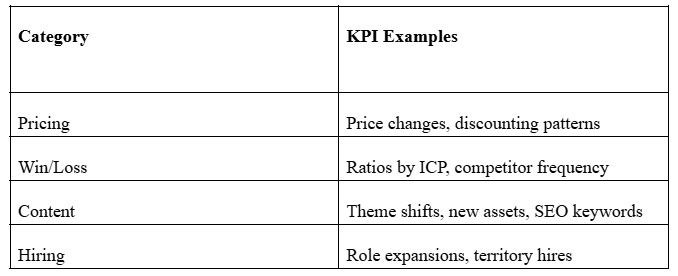
Suggested Table: AI-Tractable KPIs to Monitor
→ Want competitor-aware insights delivered in real time? Activate the OneShot Insight Agent now.
How Do You Integrate AI-Driven Competitor Intelligence with Sales Workflows?
What tools does OneShot.ai integrate with for seamless data flow?
OneShot.ai integrates with many essential sales & engagement platforms - including HubSpot, Salesforce, Apollo, Outreach, Salesloft, and LinkedIn Sales Navigator - to create a smooth flow of data across the revenue ecosystem. With these integrations, competitive and prospect insights can flow directly into CRM fields, outbound sequences, and opportunity pipelines so that they can be actionable for sales teams immediately.
How do AI-derived insights inform CRM opportunity scoring?
AI-derived insights also bring additional contextual layers to CRM opportunity scoring. Opportunity scoring can factor in things like competitor risk signals, decreases in ICP fit, indicators that a prospect may be ready to switch solutions, and how the prospect engaged with messages that the prospect knew were aware of the competitor. The result will be better context, better scoring, better prioritization, and better forecasting.
How do SDRs and AEs use competitor intelligence differently in workflows?
In terms of sales workflows, while each member of the sales team uses competitor intelligence differently, there is a common theme. SDRs use competitor intelligence to personalize outbound outreach and increase reply rates, AEs use it to navigate the dynamics of mid-stage and late-stage deals with better width of thought, and enablement teams use competitor intelligence to support the development of training materials, refine messaging, and create realistic battlecards.
What Compliance and Ethical Factors Should You Consider When Using AI in Competitive Research?
What’s legal vs. ethical when monitoring public competitor data?
When monitoring competitors, the legal and ethical boundary centers on using only publicly available information. AI can analyze public websites, regulatory filings, job postings, and product documentation, but it must not access private data, breach login-protected areas, or rely on leaked information. Staying within these limits ensures competitive research remains both lawful and ethically sound.
How do AI tools ensure compliance with GDPR and CCPA?
The responsible AI tool complies with privacy regulations, like those in the GDPR and CCPA, by using anonymized and aggregated data, retaining personal identifiers only when necessary, clearly providing options for data deletion upon request, and being open about sourcing. These steps help protect both users and individuals whose data may show up in public channels.
How should you use AI insights without breaching professional trust?
When implementing AI-derived insights, teams should maintain professional trust by using competitive intelligence to enhance positioning, never to make personal or unethical attacks. They must avoid referencing any type of information that would be considered sensitive or not public, focusing on value-driven and ethical messaging that respects both prospects and competitors alike.
FAQs
1. What is AI-powered competitor intelligence in sales?
AI-powered competitor intelligence uses machine learning and data analysis to track competitors’ pricing, positioning, messaging, customer feedback, and win-loss data—helping sales teams compete more effectively.
2. How can sales teams use AI for competitor intelligence?
Sales teams use AI to monitor competitor websites, reviews, job postings, product updates, and sales conversations, then turn that data into actionable insights for deals and pitches.
3. What data sources does AI analyze for competitor intelligence?
AI tools analyze CRM data, win-loss reports, call transcripts, customer reviews, social media, news, and web content to build a complete competitive picture.
4. Does AI competitor intelligence improve win rates?
Yes. By surfacing real-time insights on competitor strengths, weaknesses, and objections, AI helps reps tailor messaging—leading to higher win rates and faster deal cycles.
5. Which AI tools are best for competitor intelligence in sales?
The best tools combine competitive intelligence, conversation analysis, CRM integration, and real-time alerts. The right choice depends on your sales motion and team size.
6. Can AI replace manual competitive research?
AI reduces manual research effort significantly, but human sales leaders still validate insights and apply strategy during live deals.


%20(2).png)

