


Not long ago, outbound sales were all about quantity. Sales teams fired out thousands of cold emails a week, praying that sheer numbers would lead to results. But now, inboxes have never been more filled — and old-school "spray-and-pray" outreach is fast on its way to becoming background noise.
Today's buyer is busy, discerning, and immune to mass messaging. They demand relevance, timing, and personalization — and they can tell when they're being automated from a mile off.
Step in signal-based micro-campaigns: a targeted strategy in which outreach is initiated by particular purchasing signals, like a career switch, technology adoption, or interaction with your content. Rather than pursuing everyone, you reach only the right individuals at the right moment, having the best chance of valuable conversations.
In this guide, we’ll break down the differences between signal-based campaigns and volume outreach, when to use each, and how AI platforms like OneShot.ai are making high-conversion personalization possible at scale.
Schedule a Demo with OneShot.ai to see how signal-based outreach drives 5X more engagement.
What is Volume-Based Outreach?
Volume-based outreach is a sales strategy that leverages many messages - often 1000's or more - to a lot of people, while personalizing as little as possible. The idea: the more this is applied, the odds of success are getting better.
For most of the last decade, this was the norm in B2B outbound sales. Outreach, Salesloft, and of course CRMs with bulk email sent could sequence, automate, and stuff in boxes full of outsourced or even something like prospecting.
This outreach method became popular because it's low-cost to scale with automation, it's simple to train new SDRs on, and it provides transparent top-of-funnel activity.
The positives are apparent; it provides high reach, allows large lists to be contacted quickly, there's a low amount of setup effort needed with simple templates and bulk uploads, and it's easy to automate with sequencing tools.
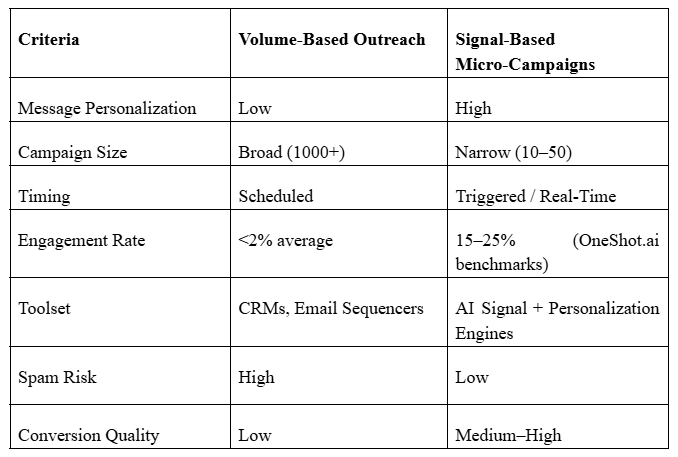
The negatives cannot be dismissed; engagement rates often result in less than 2% replies, the volume of high sending risk and high spam risk; this can damage domain reputation, and leads are frequently of low quality, with most recipients being unqualified or unengaged.
As spam filters increase in quality, Google, Microsoft, and others are tightening algorithms and implementing harder deliverability rules; the cost of high-volume, low-relevance outreach is increasing. Teams are seeing lower opens, lower replies, and higher unsubscribe rates.
External Resource: Outreach.io Blog - How to Use Volume Sequences Responsibly
What is a Signal-Based Micro-Campaign?
A signal-driven micro-campaign is an outreach series launched directly in response to a particular buying signal – a quantifiable incident suggesting likely purchase intentions.
Rather than making an educated guess as to when to contact, you wait for a trigger:
- Career changes – e.g., new VP of Sales at a target account (through LinkedIn Tracker, Sales Navigator).
- Hiring campaigns – the company begins filling openings in positions related to your product category (SignalHire, LinkedIn Jobs).
- Tech adoption – observed through BuiltWith or G2 intent data.
- Content engagement – prospect clicks on an email, downloads a whitepaper, or views a demo.
- Micro-campaigns are designed to be small - occasionally as few as 10-15 leads – and highly targeted to the signal.
For instance, if Startup X just named a sales leader, your outreach may look like this:
"Congrats on your new position at Startup X! I saw that your team is scaling — many leaders in your position use [Your Tool] to shorten ramp times for new reps. Would love to share a quick 2-minute playbook."
It's incredibly timely, leveraging a voluntary point of high receptivity. Relevance is baked in because you're responding to a specific, observable moment in time, and it feels personal versus automated.
(External Resource: LinkedIn Sales Navigator – Signals Guide)
Use OneShot.ai’s Insight Agent to identify and respond to relevant buying signals in minutes. Take the product tour.
Signal-Based vs Volume Outreach: Comparison Chart
Why Signal-Based Campaigns Win in the Modern Sales Era
1. Expectations of buyers have shifted
Buyers today crave relevant solutions at the right moment. Generic messages are ignored. Personalization, Harvard Business Review says, can increase engagement by 50+%.
2. Deliverability is tighter than ever
Google's 2023 Gmail changes punish bulk sending and increase spam filters. Signal-based sending, smaller and targeted, defends domain health.
3. Case Study – OneShot.ai in B2B SaaS
- Previous: 8% reply rate with volume sequences.
- After: 24% response rate through signal-based campaigns.
- Impact: 55% less unsubscribes, 3 times more qualified meetings.
4. Alignment with hybrid sales models
According to McKinsey's report, today's B2B buyers are active across digital and human channels. Signals enable you to meet them precisely where they are along that path.
Schedule a 15-minute demo with OneShot.ai and activate smarter outbound AI-driven signals.
When to Use Each Approach
Volume Outreach Is Ideal For: product release and awareness campaigns, launching into a new territory or market, and sending traffic to webinars or events. Signal-Based Campaigns Are Ideal For: Account-Based Marketing (ABM) initiatives, mid-funnel reactivation after initial engagement, pipeline acceleration during decision stages, and targeting high-value, strategic accounts.
The best teams utilize both strategies, going wide at first to create visibility, and then pivoting to micro-campaigns when a buying signal is triggered. OneShot.ai's Scaling Agent does this automatically and efficiently.
Use a hybrid approach using OneShot's Scaling Agent & Personalization Agent — Start your free trial.
How OneShot.ai Automates and Scales Signal-Based Outreach
The Insight Agent provides real-time signal detection by combining technographic and firmographic information, following job changes, funding rounds, tech installations, and engagement triggers.
The Personalization Agent further utilizes AI to create natural-sounding, human-like outreach messages from those signals detected, all calibrated to your tone and brand.
The Scaling Agent provides quality-controlled volume outreach, balancing the scale of micro-campaigns with relevance so you can have several small campaigns without compromising personalization.
Lastly, Seamless Integration enables OneShot.ai to integrate with HubSpot, Outreach, Salesloft, and Apollo so that your workflows remain smooth and intact.
Discover how OneShot.ai integrates with your tech stack — Book a live demo.
Tactical Blueprint: Building a Signal-Based Campaign in 6 Steps
- First, you need to identify major buyer signals, such as:
- New hiring announcements
- New product launches
- Funding announcements
- And potentially 100s of others...
Then you need to make sure you get those buyer signals into OneShot.ai's Insight Agent so that you can automate the detection of your buyer signals and ensure that you don't miss anything.
Next, let the OneShot.ai Personalization Agent develop outbound outreach messages that suit each buyer signal so it's timely and relevant to the buyer.
Segment your prospects into micro-cohorts based on each buyer signal to make it as efficient as possible, and send your campaigns from your preferred outbound platform (ie, HubSpot, Outreach, your CRM, etc).
Lastly, you can analyze your performance based on the reply rates, meeting bookings, and overall conversions to refine and improve your buyer signals and outreach messaging strategy over time.
Download our Signal-Based Outreach Blueprint for free and get a personalized audit with OneShot.ai.

Conclusion: The Future Belongs to Intelligent Outreach
Gone are the days of using volume only. Signal-driven micro-campaigns provide timing, context, and relevance — the three pillars of successful modern outbound.
If you are still using spray-and-pray, you are losing your best leads at their most attentive times. With AI doing all the heavy lifting — identifying signals, enriching data, writing messages — sales teams can finally focus on conversations and not research.
And the transition isn't only about efficiency — it's about competitiveness. As more sales teams embrace AI-powered, signal-based approaches, prospects will begin to demand hyper-relevant outreach as the baseline.
Those who keep sending generic, untimed messages will be ignored or flagged as spam. The winners in the next generation of B2B sales will be the teams who become intent detection and personalization masters at scale, leveraging tools such as OneShot.ai to make every touch matter.
Use AI signals and optimize outbound — Book a Discovery Call now.
FAQ
1. What are good examples of successful signals in B2B outreach?
Job changes, hiring announcements, funding rounds, tech adoption, and interaction with your content.
2. How many leads should you target with a micro-campaign?
Between 10 and 50, based on the signal's relevance and your team's capacity.
3. Can I automate this without sacrificing human touch?
Yes — AI personalization software like OneShot.ai creates natural, context-aware messages.
4. How does OneShot.ai make messages sound authentic?
It leverages custom brand tone models that are trained on your current top-performing outreach.
5. Does this eliminate all volume outreach?
Not at all — mass awareness campaigns still hold utility, particularly in new market entry.
6. How fast should one respond to a detected buying signal?
Ideally in hours. The sooner your outreach happens after the signal, the better your engagement levels.
7. Can signal-based campaigns be used for smaller sales teams?
Definitely — with AI taking care of detection and personalization, even sparse teams can run highly targeted campaigns at scale.
Extra Resource: Salesforce – Sales Intent Signals Guide
.png)


