.png)
The New Equation of Productivity
In the current hyper-competitive B2B sales environment, productivity is no longer a matter of being busy but rather of achieving the most output per unit of effort, cost, and time. Historically, human productivity was quantified in terms of hours worked or work completed. With AI revolutionizing the way sales teams work, however, a new factor has been introduced into the mix: AI time saved.
The capacity to automate low-value, high-volume work now enables teams to recycle human hours back into more rewarding activities, and time becomes a more strategic resource than ever before.
Nowhere is this transition more pronounced than in outbound sales. Reps need to meet ambitious targets, personalize the approach, and keep clean CRM records — frequently while investing less than 30% of their time doing actual selling (Salesforce).
Technologies such as OneShot.ai have stepped in to fill this gap by automating research, personalization, and integrations — liberating hours that would otherwise be wasted on tedious manual labor.
But the actual question is this: Are your "productive hours" really productive if your team is still wading through repetitive work?
Only 28% of a week is spent selling by sales reps, the rest being non-selling activities, as per Salesforce's "State of Sales" report.
❖ Discover how OneShot.ai revolutionizes productivity among sales teams.
What’s the Difference Between AI Time and Human Time in Sales Workflows?
How Do We Define ‘AI Time Saved’ vs ‘Human Time Spent’?
- AI time saved refers to the hours regained when intelligent automation achieves a task in less time (and often, better) than a human.
- Human time spent is the active time a rep utilizes for a task, considering the cognitive load they are holding, inefficiencies of multitasking activities at once, and weariness.
The primary difference between the two is that AI time is asynchronous, scalable, and unyielding, whereas Human time is limited and has diminishing returns.
What Tasks Are AI Best Suited to Automate in Outbound Sales?
In functions with more data, rules-based, and repeatable tasks, AI does very well in:
- Prospect research - Crawl websites/socials/databases to pull ICP-fit contacts
- Personalization at scale - Write personalized intro lines or value props using an AI agent such as OneShot.ai’s Persona or Agent.
- Platform integrations - Set up integrations to automatically keep a CRM updated or sync to platforms like Marketo (or Act-On) or log sales activity.
How Does Task Complexity Affect Time Value and Effectiveness?
- Low complexity + high volume = ideal for
- High complexity + low volume = better for human judgment.
This matrix helps teams decide when to automate, augment, or assign tasks based on ROI potential.
What’s the Opportunity Cost of Human Time Spent on Repeatable Tasks?
When humans spend 3+ hours/day on activities AI can do in minutes, it’s not just time lost — it’s pipeline value delayed. Every hour spent on manual research is an hour not spent on high-value conversations or strategic deal planning.
Why Is Measuring Time Saved with AI More Than Just Tracking Hours?
How Do You Quantify AI Time Savings in Actionable Metrics?
To move beyond gut feeling, you need tangible KPIs. Here are some examples:
- Time-to-first-touch: Speed of contacting a prospect after discovery
- Personalization speed: Seconds per email as opposed to minutes doing it manually
- Outreach volume: Messages sent each day
- MQL conversion rate: % of AI contacts that became marketing-qualified
What’s the Difference Between Perceived Productivity vs Actual ROI?
“We often confuse motion for progress. Productivity illusions happen because we measure input, not output.”
Sending 200 templated emails seems productive, but if only 2 responses, that is not a good ROI. AI tools like OneShot.ai optimize for both quality and quantity to deliver speed and precision - without compromising quality.
What Tools and Metrics Are Used to Monitor AI Productivity?
- CRM dashboards (e.g., HubSpot, Salesforce)
- Sales analytics platforms (e.g., Apollo, Outreach)
OneShot.ai reports, which provide time saved per task, rep performance, and lead quality score.
Should AI Time Savings Be Measured in Terms of Output, Not Hours?
Yes. The true value of AI isn't how much time it saves — it's what that saved time generates. More leads, more meetings, more revenue.
How Do Human-Led vs AI-Led Workflows Compare in Sales Prospecting?
What Does a Typical Human-Only Prospecting Workflow Look Like?
Here's an example of how a sales rep could spend their 8-hour day:
1.5 hrs — Manual prospect research
1 hr — Writing cold emails
1 hr — CRM updating & admin
2 hrs — Calls & follow-ups
1 hr — Email personalization
1.5 hrs — Internal meetings & planning
What Does an AI-Assisted Sales Prospecting Workflow Look Like with OneShot.ai?
Key improvements:
- Research Agent reveals ICP contacts immediately.
- Persona Agent crafts customized messaging.
- Integration Agent auto-saves CRM records.
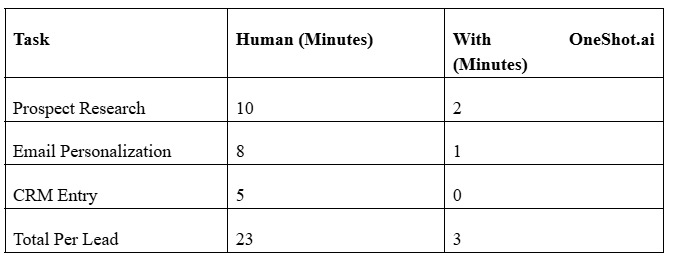
What Is the Comparative Time Investment Per Lead?
Can Quality of Outreach Decrease If Automation Increases?
Not with a tool like OneShot.ai’s Persona Agent, which makes contextual, hyper-personalized messages using real-time data. In fact, one customer stated:
"We saved 15 hours a week per rep and increased reply rates by 2.3x." - Mid-market SaaS customer.
❖ See how OneShot.ai saves reps' hours while improving conversion rates.
What Are the Key Metrics to Track AI vs Human Productivity in Revenue Teams?
What Metrics Indicate Human Productivity in Sales Outreach?
- Emails sent Cold calls made
- Meetings booked
- Time per task (tracked via activity logs)
What KPIs Measure AI’s Contribution to Pipeline Velocity?
- ICP match rates
- Lead enrichment accuracy
- Personalization scalability
- First-touch response rate
How Does AI Impact Cost Per Acquisition (CPA) and Sales Cycle Duration?
By speeding up top-of-funnel work, AI shortens the time to engagement and reduces CPA by minimizing manual hours per closed deal.
How Can OneShot.ai Integrate with Existing Dashboards to Automate KPI Reporting?
OneShot.ai integrates perfectly with CRMs such as Salesforce and HubSpot to auto-fill fields, monitor AI agent activity, and input real-time dashboards with performance indicators.
How Can You Calculate ROI from AI Time Gains vs Human Labor?
What’s the Financial Formula for Calculating Time-Based ROI?
Formula:
(Time Saved x Hourly Rep Cost) – AI Tool Cost = Net AI ROI
Example:
- 10 hours saved/week x $60/hr = $600
- Monthly tool cost = $250
- AI ROI = $350/week or $1,400/month
How Does OneShot.ai Lower Cost-Per-Lead Over Time?
AI agents get better with time and data feedback loops, so each incremental lead costs less over time — in contrast to human time, which is always linear.
What Are Industry Benchmarks for ROI in AI-Led Prospecting?
Gartner: Businesses that utilize AI for sales personalization experience up to a 30% increase in lead conversion.
McKinsey: AI-powered sales teams realize 40–60% more ROI on outbound campaigns.
Where Can Wasted Human Time Be Reallocated for Higher-Value Work?
- Discovery calls Deal strategy
- Nurturing warm leads
- Cross-functional alignment (e.g., with marketing)
❖ Utilize OneShot.ai to convert hours into higher pipeline value.

What Are the Pitfalls to Avoid When Measuring Time Savings from AI?
Why Can 'Saved Time' Be Deceptive Without Quantifiable Output?
Time saved is of little value without definite results. If released hours are not moved to high-value activities such as prospecting or closing, the gain in productivity is eliminated. Concentrate on metrics of output—leads acquired, meetings scheduled, pipeline expansion.
What's the Risk of Over-Automating Personalization?
Too much automation risks sounding robotic. Generic outreach can hurt engagement and trust. OneShot.ai’s Persona Agent ensures personalization stays relevant and human-like by tailoring messages to buyer roles and contexts.
✅ Balance speed with authenticity — especially for strategic accounts.
How Can Teams Misuse AI Productivity Reports?
Common missteps include:
- Prioritizing volume over quality
- Misreading automation success (e.g., automating low-impact tasks)
- Confusing tool performance with rep effectiveness
- Cross-reference AI metrics with revenue and engagement outcomes.
How Can Sales Managers Refocus Metrics to Long-Term Results?
Redirect attention from tasks done to the impact created. Refresh KPIs to measure:
- Lead conversion rates
- Time-to-opportunity
- Rep capacity growth
- Champion reps to reinvest free time in pipeline-driving, not admin.
What's the Future of AI-driven Productivity Measurement in B2B Sales?
Will AI Change the Way We Measure Human Work?
Yes. With AI automating routine tasks, human value will be measured by strategic thinking, relationship-building, and impact on deals — not activity quantity.
Could Predictive Analytics Trump Time-Tracking?
In the near future, dashboards can predict outcomes rather than simply track activity. Get ready for predictive insights that steer reps to the most valuable actions before they act.
What Innovations Are Coming to OneShot.ai?
OneShot.ai’s roadmap includes:
- Real-time signal analysis
- Context-aware outreach based on buyer behavior
- Self-optimizing AI agents that learn from outcomes
These tools move teams from manual effort to intelligent, automated execution.
How Will Buyers Respond to AI Personalization by 2025?
Buyers can tell the difference between shallow automation and thoughtful messaging. AI-powered personalization that reflects real needs will build trust — not break it.
❖ Request a demo of OneShot.ai to begin measuring productivity by pipeline impact, not hours worked.
FAQs
1. How much time does AI actually save at work?
AI can automate repetitive tasks like data entry, research, reporting, and follow-ups. Studies suggest professionals may save several hours per week, with projections estimating up to 12 hours saved weekly by 2029 as AI adoption matures.
2. How does AI affect overall productivity?
AI improves productivity by reducing manual effort, speeding up decision-making, and minimizing errors. Teams can reallocate saved time toward strategic thinking, creativity, and relationship-building, rather than routine tasks.
3. How is your team spending the time saved by generative AI?
Most teams reinvest AI-saved time into higher-value work, such as customer engagement, product innovation, skill development, and performance optimization. Measuring this redistribution is key to understanding real ROI.
4. What metrics should be used to measure AI productivity?
Key metrics include time saved per task, output per employee, task completion speed, cost reduction, and revenue impact. Comparing AI-assisted workflows with human-only processes provides clear benchmarks.
5. Is AI productivity measurable in real business terms?
Yes. Productivity gains can be measured through hours saved, reduced operational costs, faster cycle times, and increased revenue per employee, making AI impact tangible and trackable.